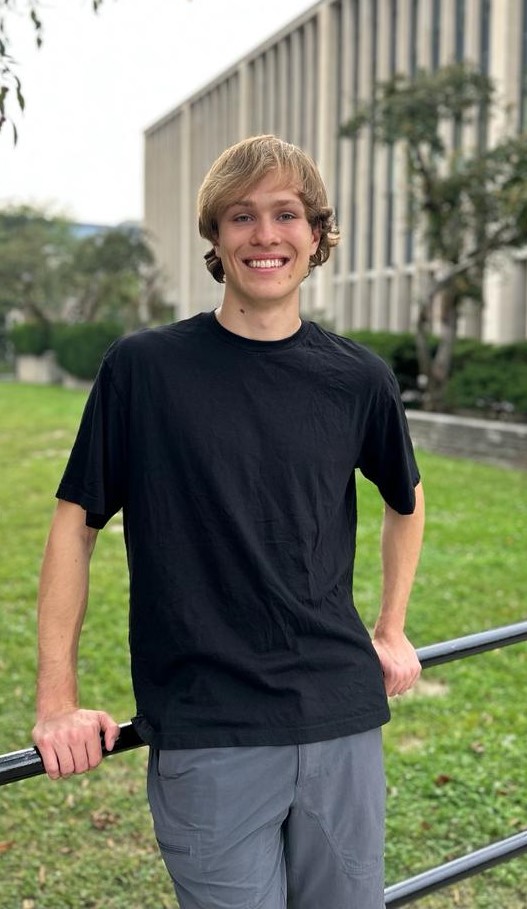
Jasper Gerigk
Computer Science PhD Student
University of Toronto
I am a third-year PhD student at the University of Toronto supervised by Professor Gilitschenski at the Toronto ISL lab. My research focuses on policy learning for robot manipulation, especially generalizable and robust vision-language-action models.
During my undergraduate studies at the University of Toronto, I received an honorable mention in the Computing Research Association’s Outstanding Undergraduate Researcher Award program. My previous research includes object-oriented reinforcement learning with foundational computer vision models at TISL, and graph neural networks and reinforcement learning for traffic management during an internship at Bosch Corporate Research. I also applied geometric deep learning to learning strategies for the deck-building game Dominion under the supervision of Professor Engels.
- Artificial Intelligence
- Robotics
- Reinforcement Learning
- Vision-Language-Action Models
- Vision-Language Models
PhD in Computer Science, 2024–present
University of Toronto, Canada
BSc Computer Science Specialist and Mathematics Major, 2024
University of Toronto, Canada
IB Diploma, 2019
Metropolitan School Frankfurt, Germany
PUBLICATIONS
EXPERIENCE
Methods applied: PyTorch, VLM, VLA, ROS, Aloha, Franka
Initially worked as DSI SUDS Scholar and presented results at DSI SUDS Showcase
Methods applied: Python, PyTorch, JAX, SLURM

Worked on combining pre-trained computer vision models with reinforcement learning
Methods applied: Pytorch, JAX, Rainbow, SAM, FastSAM

For the first time, used large-scale customer fleet data to analyze lateral vehicle movement to improve comfort of lane following assistant
Methods applied: Spark, Azure Databricks, Frequentist and Bayesian statistics in Python

Development of multi-agent reinforcement learning algorithms for centralized planning of connected self-driving vehicles using graph neural networks
Methods applied: DQN, TD3, RCGN, GAT implemented in Python using PyTorch

Contributed to backend by integrating machine learning methods using Python


TEACHING EXPERIENCE
EDUCATION

GPA: 3.97/4.0
Programs:
- Computer Science Specialist
- Focus In Artificial Intelligence
- Mathematics Major
Advanced Courses:
- CSC311: Introduction to Machine Learning
- CSC324: Principles of Programming Languages
- CSC412: Probabilistic Learning and Reasoning
- CSC413: Neural Networks and Deep Learning
- CSC420: Introduction to Image Understanding
- CSC494: Computer Science Project: Developed and published agent for Dominion under supervision of Professor Engels
Awards:
- 2020, 2023 - Dean’s List Scholar
- 2019 - Millard Scholarship ($1208)
- 2023 - Dr. James A. & Connie P. Dickson Scholarship in Science & Mathematics ($500)
- 2023 - University of Toronto Scholar ($1500): Recognizes the most outstanding students across all three campuses of the University of Toronto
- 2023 - Computing Research Association Outstanding Undergraduate Researcher Award Honorable Mention
GPA: 3.8/4.0; courses recognized as transfer credits by the University of Toronto